Part II — Jodhpur
There are occasions when economy class represents perfectly good value. A working journey across India and Indonesia isn't one of them.
I leave Almaty with Air Astana. Business class isn't about champagne at ten in the morning; it is about arriving able to work. Delhi is only a few hours away, but there are several weeks of travelling ahead and very little virtue in beginning them tired. The contrast begins before landing.
Almaty in October is already turning towards winter. The mountains are whitening and the clothes I wore to the airport made perfect sense when I left the house. Delhi, even at this time of year, belongs to another climate entirely.
Delhi is my point of entry rather than my destination this time. India entered, bag collected and the necessary airport choreography completed, I take the short domestic flight west to Jodhpur.
From the air Rajasthan already looks different.
The green retreats. The earth becomes harder. Colours move towards sand, ochre and red.
At Jodhpur airport a car is waiting. The heat outside is immediate, dry and considerably more persuasive than the air-conditioning I have just left behind. Before long the great sandstone mass of Mehrangarh appears above the city. I stay at RAAS.
A Different Kind of Palace
I had stayed at Umaid Bhawan Palace during earlier visits to India in the late 2000s. It is an extraordinary place: immensely grand, beautifully maintained and almost absurdly opulent. As a building it deserves to be experienced at least once. But intimacy isn't its strength.
There were moments when staying there felt less like being a guest in Rajasthan and more like receiving a temporary appointment to the colonial administration. The scale, the lawns, the corridors, the ceremony of it all - magnificent, certainly, but capable of leaving you strangely detached from the city outside.
RAAS is a newer proposition and, for me, a much more interesting one. It is conceptually and architecturally very well judged. There is no attempt to compete with Jodhpur's great monuments, nor to recreate the manicured parkland of a palace hotel.
Instead, there is stone.
Hot sandstone terraces replace great lawns. Historic walls meet restrained contemporary architecture. Black terrazzo, timber, leather and white marble sit alongside the rose-red sandstone from which so much of Jodhpur appears to have been made.
And above everything is Mehrangarh.
I take the suite above the old stepwell, itself dating from 1740. At around 1,250 square feet it is more space than one man needs, but that isn't really the reason for choosing it.
The reason is outside.
The suite moves through a bedroom, smaller second room, day-bed alcove and kitchenette, but the interiors are deliberately restrained. That is important, because there is very little an interior designer could sensibly add to what is happening beyond the windows.
From the bed, the old city stretches away in blue-washed rooftops. From the terrace, the view opens more completely.
And above it all is the fort.
Mehrangarh doesn't sit politely in the distance as part of a picturesque landscape. Its monolithic sandstone mass rises almost directly out of the city and peers down on you.
You become conscious of it everywhere.
Drinking tea in the morning.
Crossing the terrace barefoot.
Sitting outside as the heat begins to leave the stone.
Looking up from a book.
It is simply there.
The relationship between the suite and the city is what makes the place work. The polished black floor beneath my feet, the rose-red sandstone outside, the blue houses beyond and then that immense red fort above them seem less like a hotel colour scheme than different layers of the same place.
Even the luxury is relatively quiet.
A pot of tea in the morning. Newspaper on the table. Something small for breakfast. The doors open to the terrace while the temperature still allows it. Outside, the stone is already beginning to warm.
There is no great lawn separating me from Jodhpur. No ceremonial drive. No sense that the city has been edited out for the comfort of the guest.
The stepwell is below.
The Blue City is outside the window.
Mehrangarh is above.
RAAS doesn't insulate you from Jodhpur.
It puts you inside it.
Open the curtains and there is no framed print of Rajasthan on the wall. There is Rajasthan.
Red Above, Blue Below
I first visited Mehrangarh almost twenty years ago.
Time has done remarkably little to diminish it.
There are buildings whose effect depends on novelty. Mehrangarh isn't one of them. If anything, returning makes its scale more difficult to comprehend. I know what is waiting above the city this time, and it is no less impressive.
The approach is steep and deliberately awkward, climbing through a succession of gates beneath walls that appear less constructed than carved out of the escarpment itself. The heat is already gathering in the sandstone.
Passing through the gates, I remember one of the more macabre stories from my first visit.
When Rao Jodha began the fort in the fifteenth century, legend has it that the hermit displaced from the hill cursed the new stronghold. To defeat the curse, a man named Rajaram Meghwal is said to have volunteered to be buried alive in its foundations, his sacrifice intended to bring good fortune to the fort and those who lived within it. I remember being struck by the story twenty years ago.
I am struck by it again now.
Apparently his luck worked rather better for the fort than it did for him. I am hoping mine holds for the remainder of the trip.
Beyond the gates, Mehrangarh begins to reveal the curious contradiction at its heart. From outside it is almost brutally defensive - immense walls, rock and mass. Inside are courtyards, carved screens and rooms of extraordinary delicacy, accumulated and altered over centuries.
Then there is the view.
Jodhpur falls away beneath the ramparts in an irregular field of flat roofs, terraces, water tanks and narrow lanes, much of it washed in shades of blue. There are various stories explaining the blue houses of Jodhpur, some more convincing than others. Their historical association is particularly with Brahmin households, although the colour long ago spread beyond any simple social boundary. Standing above the city, the academic explanation feels rather less important than the effect.
Red sandstone beneath my feet.
Blue houses below.
Hard white sun above.
Almost twenty years later, that view has lost none of its effect.
To Work
The following morning the tape measure finally comes out of the bag. This is, after all, why I am here.
I meet with our maker and we begin with timber.
A new batch of first-grade Indian rosewood has arrived and I want to see it before too much of it disappears into production.
Selecting timber is one of those processes that sounds unnecessarily obsessive until two supposedly identical pieces of furniture are placed beside one another. They are never identical.
Boards are pulled from the stack individually.
Colour first.
Then grain.
Figure.
Straightness.
Sapwood.
Defects.
And, more importantly, what each board might become.
A spectacular piece of timber isn't necessarily a useful one. Strong figure that would make a beautiful drawer front may be entirely wrong for a long structural rail. A quieter board may be much more valuable where consistency matters. This is one of the pleasures of working in real materials.
Wood refuses to become completely standardised.
You work with it rather than merely specifying it.
Some boards are put aside.
Others go back into the stack.
A few are immediately obvious.
Those stay out.
Twenty Millimetres
Then the drawings come out.
There is a new commission to review.
Design on paper is wonderfully obedient. Timber is less so, and the man expected to turn a drawing into furniture tends to have opinions of his own.
This is a good thing.
Dimensions are checked. Proportions discussed. A rail that looked perfectly satisfactory on the drawing suddenly appears slightly too heavy. Something else needs more material rather than less. A joint that is elegant in section needs reconsidering once the actual grain direction is taken into account. The tape measure moves backwards and forwards across the drawing and then across an existing piece.
Twenty millimetres disappears.
Ten comes back.
A line is redrawn.
The maker suggests another way.
We argue about it.
He is right.
The drawing changes.
This is how the better pieces develop.
Not through a designer producing an immaculate image thousands of miles away and instructing a workshop to reproduce it unquestioningly, but through an idea being tested against timber, tools and the experience of the person who actually has to make it.
The original intent remains.
The object gets better.
Looking Where Nobody Looks
There is also a recently completed order waiting for inspection.
This is the less romantic part of making furniture and perhaps the more important one.
From across a room, almost everything looks good.
So I get closer.
Drawers are opened and closed.
Doors are checked.
Margins compared.
Surfaces are viewed across the light rather than directly into it. A hand runs over the polish.
Furniture is turned around.
I look at backs.
Underneath.
Inside.
At the places nobody photographs.
Particularly at the places nobody photographs.
Handmade is not, by itself, a guarantee of quality. It simply means that somewhere along the process a human being had the opportunity to get something wonderfully right or irritatingly wrong.
Most of the order is exactly as it should be.
One detail isn't.
It is small. The sort of thing that could quite easily be ignored because the customer might never notice it.
I notice it.
More importantly, the maker notices that I notice it.
There is no great discussion.
The piece is marked and goes back to the bench.
That is quality control.
Not a paragraph on a website about an uncompromising commitment to excellence. A piece going back to the bench when it would have been easier to let it leave.
Dinner Away From Home
Residency at RAAS affords me three very good meals a day without ever needing to leave its walls. This is extremely convenient and, after a few days, potentially a mistake.
However good the hotel, I have never liked visiting a city entirely from inside the hotel I am staying in.
So one evening I have a reason to leave.
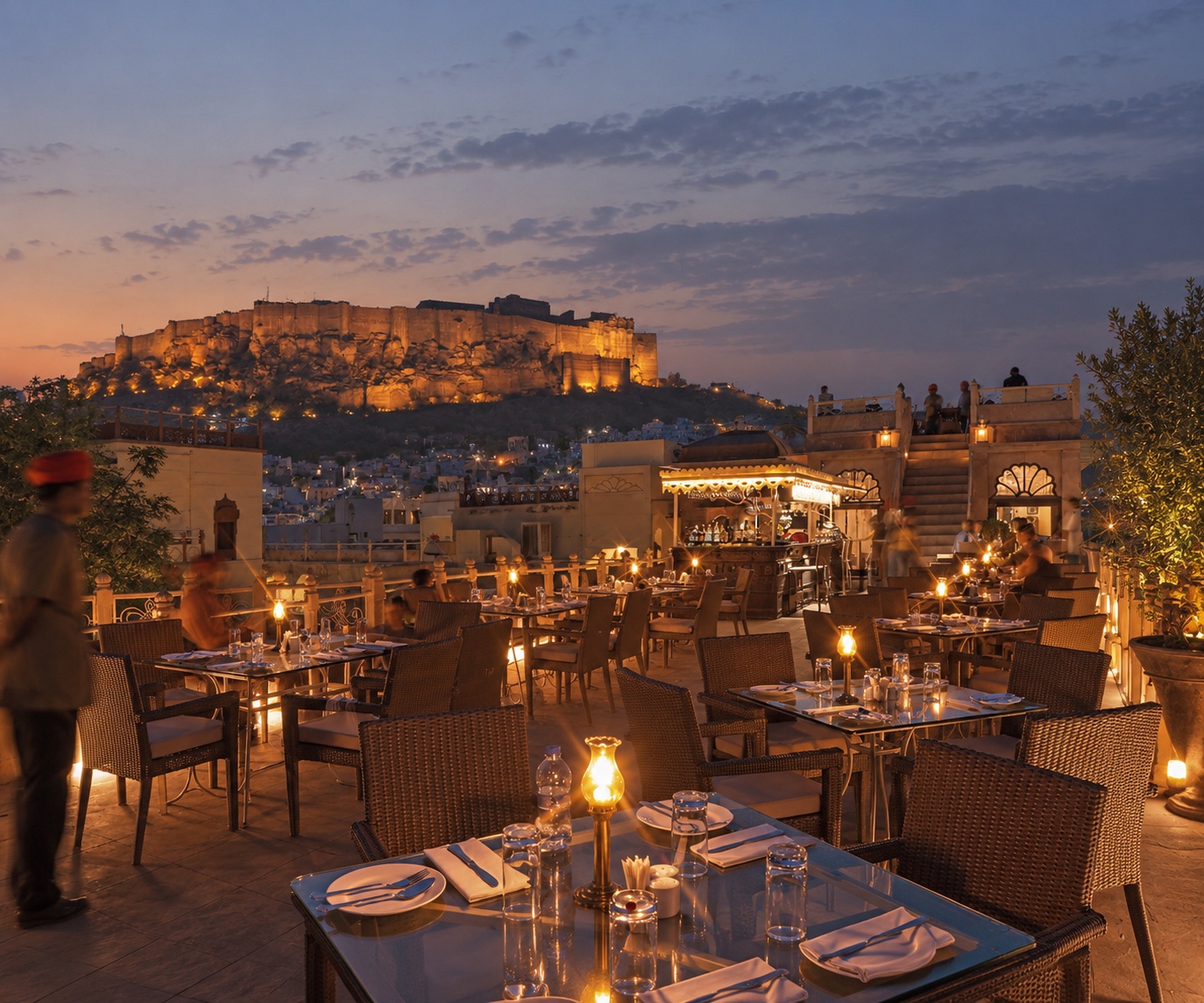
I am meeting a colleague at 19:30 at Indique, the rooftop restaurant at Pal Haveli -itself a very decent heritage hotel in the old city, close to the Clock Tower. By half past seven the worst of the day's heat is finally beginning to leave Jodhpur. I shower and change into a clean linen shirt and lightweight trousers. The Ferragamo Cayman loafers packed back in Almaty finally earn their place in the bag -soft, light and just formal enough for dinner without looking as though I have dressed for it.
I head through the old city towards Pal Haveli.
Pal Haveli is very different from RAAS. It is an old family haveli rather than an architectural reinterpretation of one, and Indique occupies its upper terrace. The attraction becomes obvious as soon as I reach the roof.
Jodhpur is spread around the table.
The Clock Tower and Gulab Sagar sit below, Umaid Bhawan is visible in the distance and, dominating everything once again, Mehrangarh rises above the old city. As daylight disappears, the fort begins to illuminate, the red sandstone slowly changing character against the darkening sky.
My colleague arrives and we order without making too much of a project of it. Laal maas first - the great Rajasthani mutton curry, dark with Mathania chilli and considerably more serious than its colour initially suggests.
Alongside it, gatta curry: gram-flour dumplings in a yoghurt-based sauce, softer and more restrained against the meat.
Bajra roti.
Rice.
Yoghurt.
A simple vegetable.
And fresh lime soda.
The laal maas is excellent.
Hot, certainly, but not pointlessly so. The chilli sits behind the flavour of the meat rather than obliterating it, and the coarse millet bread is exactly what it needs. The gatta provides relief before I inevitably go back for another piece of mutton. There are more elaborate meals to be had in India.
I am not convinced there are many more satisfying ones.
We talk business for a while, then increasingly less business as dinner progresses. Below us, the old city carries on with its evening. The accumulated heat of the day is finally lifting from the rooftops. Above them, Mehrangarh is now fully illuminated. Almost twenty years after I first saw it, I appear to have spent most of this visit looking at the same fort from different directions.
There are worse habits.
Eventually dinner is finished, the plates disappear and there is no particular reason to rush back.
For all the comfort of RAAS, this is why one occasionally has to leave the hotel. A rooftop.
A colleague.
An excellent curry.
A warm evening becoming cooler.
And one of the great views in Rajasthan sitting quietly behind the table. It is difficult to improve upon the arrangement.
I walk back through the old city towards RAAS.
Around the market, tomorrow's traders are already laid out on their carts. Some are still awake, reclining beneath the open sky and looking up at the stars. Others are fast asleep amongst the boxes and produce, apparently without a care in the world. There is something enviable in the ease of it.
No elaborate preparations for the night. No concern for where one ought to be. The day's work is finished; tomorrow's is already waiting beside them. For now, the cart is a bed and the warm night is enough.
I continue through the quieter streets.
Above the rooftops, Mehrangarh is still illuminated. Behind me the market sleeps; ahead is the rather different comfort of RAAS.
Back in the suite, the doors are open onto the terrace and the sandstone has finally surrendered most of the day's heat.
In the morning I take tea outside before packing.
The work here is done. The rosewood is selected, the new commission has moved from drawing towards something that can actually be made, and the completed pieces have been inspected. There is satisfaction in leaving things at that point - not finished, exactly, but moving in the right direction and in capable hands. I take one last look at the fort.
Almost twenty years separate my first visit from this one. Jodhpur has changed, as I undoubtedly have, but Mehrangarh appears entirely indifferent to both facts. The car arrives.
Jaipur is next