ROSEWOOD
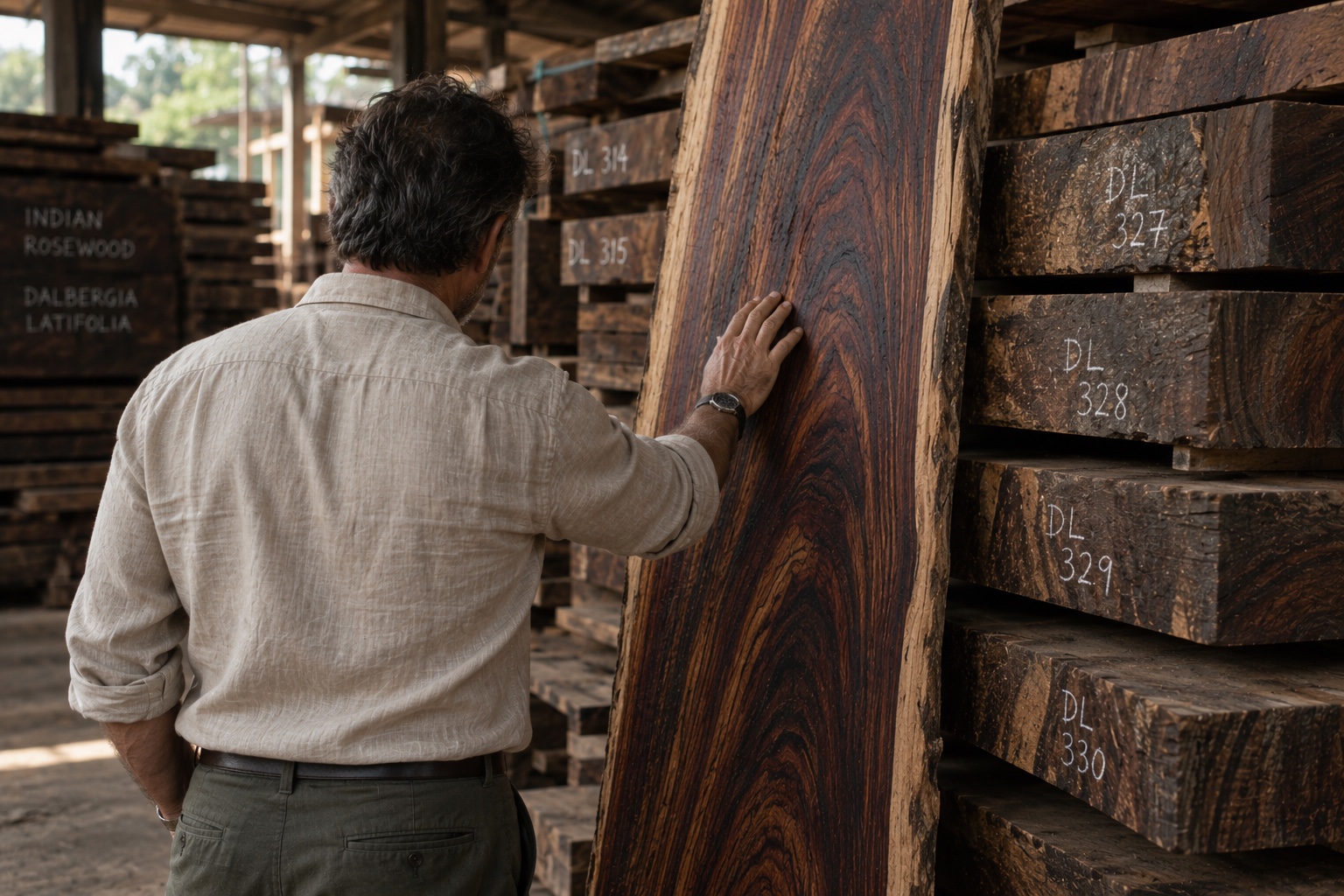
There are materials that become expensive because they are fashionable, and there are materials that become fashionable because they are exceptional.
Rosewood belongs firmly in the latter category.
For centuries it occupied a peculiar position in furniture making. Dense, strong and naturally durable, it could be carved, turned, veneered and polished to an extraordinary depth. Browns ran into red and violet, crossed by almost black figuring that sometimes appeared drawn onto the timber in ink.
Even its name came from the experience of working it: freshly cut rosewood has a distinctive sweet aroma.
But beauty alone doesn’t explain the obsession.
Rosewood could do something particularly valuable for a furniture maker. It could provide the decoration itself.
An exceptional board didn’t require elaborate carving, excessive ornament or complicated finishing to create presence. Sometimes four legs, a top and good proportions were enough.
The material did the rest.
And therein lies the problem.
THE ROSEWOOD THAT DISAPPEARED
The benchmark is Brazilian rosewood, Dalbergia nigra.
Also known as Rio rosewood or jacarandá-da-Bahia, it came from Brazil’s Atlantic Forest and found its way into European workshops for centuries.
The finest examples explain the obsession immediately.
Chocolate brown can move through burgundy, purple and black within a single board. Dark lines wander unpredictably through the grain. Once polished, the surface develops an optical depth that stain struggles to imitate.
And it ages beautifully.
The brighter colours of freshly worked timber gradually settle into the deep brown, reddish-black tones associated with old rosewood furniture.
Furniture makers were not alone in recognising its qualities. Instrument makers prized Brazilian rosewood for many of the same reasons cabinetmakers did, together with its acoustic properties. It became particularly celebrated in guitar making.
Different crafts, with very different requirements, kept arriving at the same material.
This wasn’t a reputation invented by marketing.
Brazilian rosewood really was exceptionally good.
Unfortunately, everyone noticed.
WHEN A GREAT MATERIAL BECOMES TOO SUCCESSFUL
Brazilian rosewood was exploited intensively while its natural Atlantic Forest habitat was simultaneously being cleared and fragmented by agriculture, settlement and development.
It would be too simple to blame the disappearance of the species on furniture making alone.
The reality is more complicated.
But valuable mature trees growing within a rapidly diminishing forest were never going to fare particularly well.
In 1992, Dalbergia nigra was placed on CITES Appendix I, the highest level of international trade protection.
That fundamentally changed its commercial future.
Documented pre-Convention timber and certain antique or historic material can still exist legitimately, but Brazilian rosewood is no longer a sensible timber around which to design contemporary furniture production.
Which creates an extraordinary paradox.
One of history’s most coveted cabinet woods became even more desirable at precisely the moment it became almost impossible to use.
WHY DON’T WE JUST GROW SOME MORE?
It seems an obvious question.
If Brazilian rosewood is so valuable, why not simply plant millions of trees?
The difficulty is time.
Fine cabinet timber isn’t an agricultural crop that can be harvested every season. The trees capable of producing wide, mature, richly coloured boards represent decades of growth.
And simply producing a tree of the correct species doesn’t guarantee extraordinary timber.
Soil, climate, growth rate, competition, age and growing conditions all influence what eventually appears when the log is opened.
The relevant question therefore isn’t:
How many rosewood trees exist?
It is:
How many mature trees exist capable of producing the quality and dimensions required for exceptional furniture?
That is a rather different number.
THE SEARCH MOVES TO INDIA
If Brazilian rosewood is effectively unavailable for normal contemporary production, the obvious question is what comes next.
For us, that search leads to India.
Indian rosewood, Dalbergia latifolia, belongs to the same botanical genus as Brazilian rosewood.
It isn’t Brazilian rosewood with a different passport.
Nor should it be presented as one.
Its character is different.
Brazilian rosewood can be extraordinarily flamboyant, with dramatic changes of colour and almost calligraphic black figuring.
Indian rosewood is generally more restrained: chocolate, purple-brown and deep black, often with long darker streaks running through the board.
In some ways, we prefer that.
A great deal of KIRSANOV furniture already has a strong architectural character. Turned legs, leather, brass, inlay and unusual proportions don’t necessarily need another material shouting for attention.
Indian rosewood can be quieter.
But quiet shouldn’t be confused with ordinary.
A really exceptional piece is magnificent.
“ROSEWOOD” ISN’T GOOD ENOUGH
There is another complication.
Rosewood has become an extraordinarily elastic commercial term.
Timbers of varying species, quality and origin are routinely described using the name. There are rosewood finishes, rosewood stains, rosewood colours and rosewood-effect laminates.
There is a certain irony here.
As genuine rosewood became harder to obtain, the word rosewood became easier to obtain.
For our purposes, “rosewood” written on an invoice isn’t sufficient.
We are specifically interested in Dalbergia latifolia.
That botanical name matters because when considerable money, manufacturing time and international transport are involved, ambiguity isn’t charming.
It is expensive.
BUYING THE SPECIES IS THE EASY PART
Finding a merchant who says he has Indian rosewood isn’t particularly difficult.
Finding enough Indian rosewood that we actually want is something else entirely.
This is where procurement becomes part of the design process.
One board may be extraordinary.
The next may be thoroughly ordinary.
Colour varies between trees. Grain varies through the log. Sapwood reduces usable width. Boards can contain checking, end splits, distortion and other defects. Drying and previous storage matter enormously.
Then there is the question of matching.
Two cabinet doors shouldn’t look as though they came from different forests.
Drawer fronts should relate to one another.
Long rails require straight, stable material.
Turned components have different requirements again.
And the most spectacular board in the stack probably shouldn’t disappear into the back of a cabinet.
This isn’t buying timber by the cubic metre.
It is selecting individual boards for individual jobs.
THE BEST BOARD IS ALWAYS AT THE BOTTOM
This is the part of furniture making that doesn’t fit particularly neatly into a specification sheet.
You stand in a timber yard looking through stacks of rough-sawn boards.
One comes out.
No.
Another.
Possibly.
Another has beautiful colour but a split running through precisely the section we need.
One is too narrow.
Another has enough sapwood to make the useful portion considerably smaller than the board suggests.
Then something unpromising appears.
A small section is planed, scraped or wetted.
Suddenly the almost-black rough surface becomes purple-brown with deep streaks running through it.
That’s the one.
Then comes the difficult question.
Do you have another twenty like it?
Usually, that is where things become interesting.
WIDE BOARDS CHANGE EVERYTHING
Modern materials have made us forget how extraordinary width can be.
A sheet of plywood or MDF can produce a broad, perfectly flat surface without anybody giving it a second thought.
A tree cannot.
If we want a large rosewood bureau fall, cabinet door or table top, obtaining wide, stable and visually exceptional material becomes increasingly difficult.
Boards can of course be joined.
But then grain and colour have to be matched.
There is another solution.
Veneer.
And there should be no embarrassment whatsoever about using it.
Some of the greatest furniture ever made employs veneer. Historically it wasn’t merely a way of making expensive timber cheaper. It allowed cabinetmakers to use exceptional material intelligently.
A beautiful log could be sliced, mirrored, book-matched and composed in ways impossible with a single solid board.
For us the question therefore isn’t whether solid timber is “better” than veneer.
It is:
Which construction allows this particular piece of timber to do the most?
THEN THERE IS THE PAPERWORK
Indian rosewood remains available, but the world of rosewood is now regulated for good reason.
International trade in Dalbergia species is controlled through CITES, while India maintains its own forestry, movement and export controls.
That doesn’t mean legitimate Indian rosewood furniture cannot be made.
It means provenance matters.
Where did the timber originate?
Who supplied it?
Can the supplier identify the species?
Was it legally procured?
What documentation follows the material and, where required, the finished furniture?
For us, those questions aren’t bureaucratic inconveniences sitting outside the design process.
They are part of buying the wood.
A suspiciously cheap parcel of rosewood with an uncertain history isn’t cheap at all.
THE REAL COST OF ROSEWOOD
There is also a tendency to discuss expensive timber in terms of its price per cubic metre.
That figure tells only part of the story.
The real cost includes the boards rejected at the yard, material lost through defects, seasoning losses, storage, transport, documentation, machining, tool wear, matching, unusable offcuts and the additional labour involved in deciding where each board belongs.
Buy a stack of expensive rosewood and only part of that stack may ultimately meet the standard required for the visible areas of a piece of furniture.
That is why very cheap “solid rosewood furniture” deserves a degree of curiosity.
Something has made it cheap.
The species, the grade, the drying, the construction, the provenance, the labour—or perhaps several of them.
IS IT BETTER THAN TEAK?
Not really.
It is different.
Teak remains one of the world’s great furniture timbers. It is durable, stable, forgiving and extraordinarily well suited to furniture expected to survive generations of use.
For much of what we make, teak makes considerably more sense.
Rosewood is heavier, harder and less forgiving. Matching it is more difficult. Exceptional material is harder to find and the supply chain demands more attention.
But rosewood can do something that teak rarely does.
It can become the principal decorative element of the furniture.
A cabinet door can become a composition.
A table top can become the reason the table exists.
That is where the trouble begins to make sense.
BRAZILIAN OR INDIAN?
Put exceptional examples beside one another and Brazilian rosewood often possesses greater visual complexity.
There can be an almost chaotic beauty to it.
Indian rosewood is generally darker and more restrained.
But ultimately the comparison becomes slightly unfair.
We are comparing a timber that can still form part of contemporary furniture making with one whose historical exploitation helped make normal commercial use effectively impossible.
Brazilian rosewood is increasingly an historical benchmark.
Indian rosewood remains a material with which we can actually work.
And there is another problem with comparing species.
Not every piece of Brazilian rosewood was magnificent.
Not every piece of Indian rosewood is magnificent.
A botanical name doesn’t guarantee beauty.
One exceptional Dalbergia latifolia log can render an argument about which species is theoretically superior rather irrelevant.
Because ultimately we aren’t buying a species.
We are buying individual trees. Individual logs. Individual boards.
SO, IS IT WORTH IT?
For mass-produced furniture?
Probably not.
There are easier timbers, cheaper timbers and vastly easier supply chains.
For us?
Yes.
But selectively.
We have no ambition to make everything from rosewood.
That would be expensive, unnecessarily difficult and, perhaps worst of all, would make an exceptional material ordinary.
Instead, we want it where the timber itself contributes something fundamental to the furniture.
A cabinet whose doors allow the grain to become decoration.
A bureau where dark rosewood sits against leather, brass or a contrasting interior.
A table whose top deserves to be examined from a few inches away.
And if we find an extraordinary parcel of timber, perhaps the process should occasionally work in reverse.
Rather than designing a piece in London, specifying rosewood and demanding that somebody find enough timber to make it, perhaps we should first find the wood.
Then decide what it deserves to become.
That is hardly a revolutionary idea.
Cabinetmakers worked that way for centuries.
MATERIAL AS LUXURY
Modern luxury has a tendency to add things.
More stitching.
More metal.
More lacquer.
More ornament.
More branding.
An extraordinary natural material offers another possibility.
Remove things.
Allow the proportions to work.
Make the joints properly.
Finish the surface beautifully.
And then have sufficient confidence to leave the timber alone.
That, ultimately, is why we are prepared to go looking for Indian rosewood.
Not because it is rare.
Not because its name sounds expensive.
And not because we are trying to recreate Brazilian rosewood.
We are looking because, occasionally, somewhere within a stack of rough, dusty boards, there is a piece of timber good enough to determine the furniture built around it.
The difficult part isn’t finding rosewood.
It is knowing which rosewood is worth the trouble.