FROM SHELLAC TO FRENCH POLISH
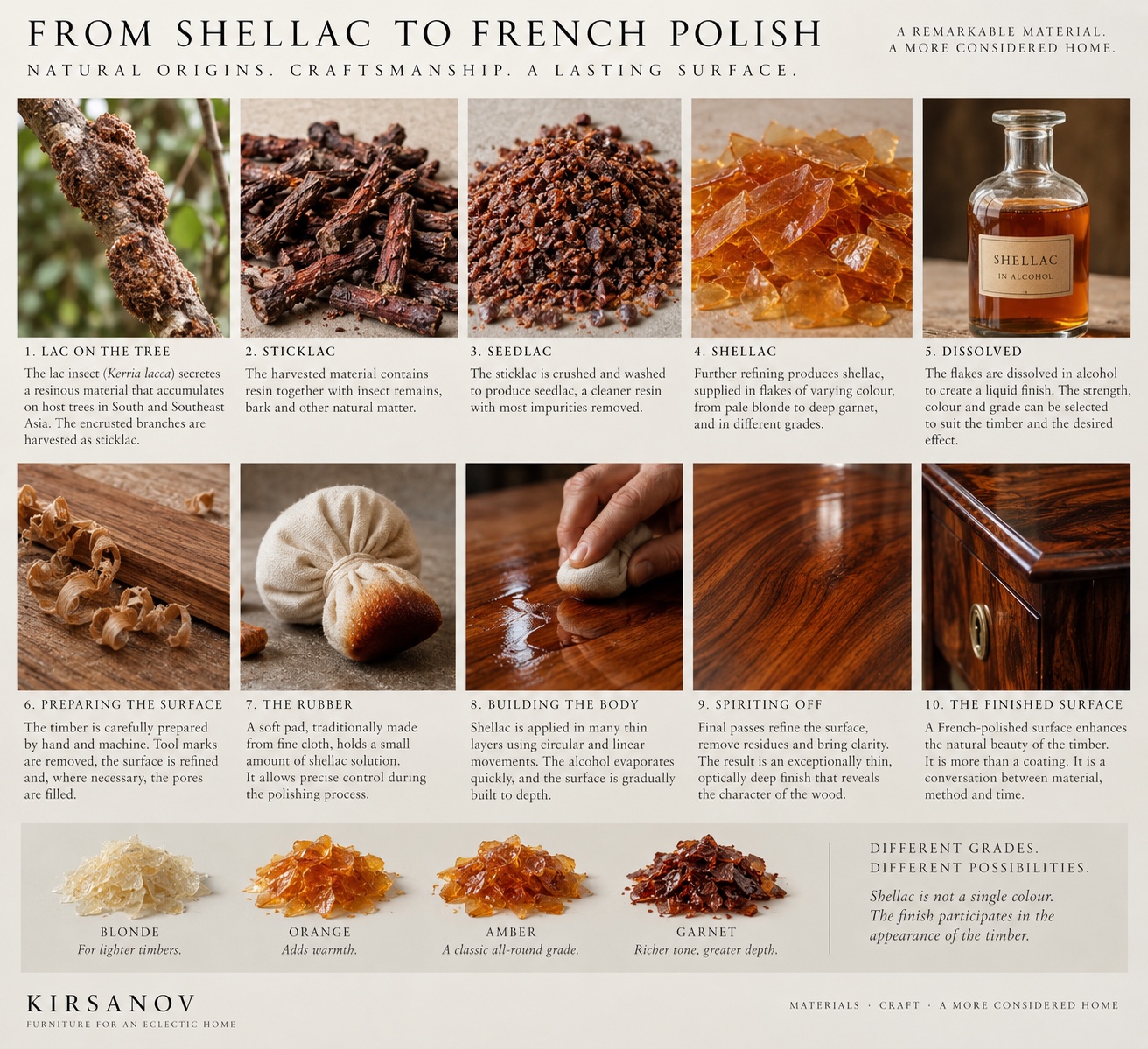
Few furniture finishes are as frequently named and as commonly misunderstood as French polish.
The expression is often used as though it describes a substance: a bottle of finish that can be purchased and applied to timber.
Strictly speaking, it does not.
The material traditionally responsible for the surface is shellac.
French polishing is a method of applying and manipulating that material.
The distinction is important because shellac can be brushed, sprayed or padded. It can be used as a sealer, as an intermediate coating or as the principal finish. French polishing represents something more specific: the gradual construction and refinement of an exceptionally thin shellac film through repeated application with a polishing pad.
The process can produce surfaces of remarkable clarity and optical depth, particularly on richly coloured cabinet woods such as mahogany and rosewood.
Modern chemistry has subsequently produced finishes that are harder, more resistant and considerably faster to apply.
French polishing nevertheless survives.
Understanding why requires beginning not with the polishing bench, but with an insect.
From Lac to Shellac
Shellac is unusual among traditional furniture finishes because its principal raw material is neither a plant oil nor a tree resin.
It originates with the lac insect, principally Kerria lacca, which lives on particular host trees in South and Southeast Asia.
The insects feed upon the host and secrete a resinous protective material that accumulates around the branches. These encrusted branches can be harvested to produce what is traditionally known as sticklac.
The raw material contains resin together with insect remains, fragments of bark and other natural material. Processing progressively removes these impurities.
Crushed and washed material produces seedlac.
Further refining produces shellac.
The finished resin can then be supplied in thin flakes or other forms and subsequently dissolved in alcohol to create a liquid furniture finish.
This apparently obscure natural material became one of the most important finishing substances in cabinetmaking.
Its success was not accidental.
Shellac dries extremely rapidly as its alcohol solvent evaporates. It adheres to many surfaces, produces a clear film, can be built in very thin layers and responds particularly well to polishing and repair.
These characteristics made it exceptionally adaptable.
Shellac Is Not a Single Colour
Shellac is sometimes imagined as a completely colourless coating.
Historically this was rarely the case.
Different grades and methods of processing produce shellac ranging from very pale material through warm amber and orange tones to considerably darker grades such as garnet.
Traditional button lac represents another form, historically produced as small discs or buttons rather than flakes.
Shellac can also contain its naturally occurring wax or be processed into dewaxed grades.
These differences matter.
A pale shellac can preserve much of the natural appearance of a light timber.
A warmer grade can enrich mahogany, rosewood and similarly coloured woods, subtly changing the way their reds and browns are perceived.
The finish therefore does not merely sit invisibly above the timber.
It participates in its appearance.
This partly explains the difficulty of reproducing the colour of old furniture through stain alone.
What we perceive in a historic surface may be the cumulative result of the original timber, oxidation, any initial dye or stain, pore filling, the natural colour of the shellac and decades—or centuries—of subsequent ageing.
There is rarely a single “colour” to reproduce.
The Surface Begins Before the Finish
An exceptional polished surface cannot correct poorly prepared timber.
Indeed, highly reflective finishes frequently make defects more obvious.
Traditional cabinetmaking therefore placed considerable importance on preparing the substrate before polishing began.
Tool marks had to be removed.
Scraping and sanding progressively refined the surface.
Edges had to remain crisp.
Any defects requiring correction were dealt with before the finishing process began.
Open-pored timbers introduced another problem.
Mahogany and many rosewoods possess visible pores. Applying finish directly over them without preparation can leave a surface containing thousands of small depressions.
One solution is simply to build sufficient coating thickness to bury the texture.
Traditional polishing generally takes a more restrained approach.
The pores are filled.
Historically, extremely fine pumice could be worked into the surface during French polishing. Combined with material from the timber and the developing finish, it helps fill the pore structure without requiring the entire piece to be encapsulated beneath a thick transparent film.
This distinction becomes fundamental to the finished appearance.
The objective is not to create a new surface above the timber.
It is to refine the timber surface itself and then protect it.
The Rubber
The characteristic tool of French polishing is deceptively simple.
It is not a brush.
The traditional polishing pad—commonly called a rubber or fad—is made from an absorbent inner material surrounded by a finer outer cloth.
Shellac solution is introduced into the pad rather than poured directly onto the furniture.
The outer surface then delivers extremely small quantities of material as the pad moves across the timber.
This control is essential.
French polishing does not normally proceed by applying a heavy wet coat and waiting for it to dry.
The film is accumulated gradually.
Circular movements, figures-of-eight and longer straight passes may all be employed at different stages and on different surfaces.
The alcohol evaporates rapidly.
A minute quantity of shellac remains.
The process is repeated.
And repeated again.
The simplicity of the materials disguises the skill involved.
Too much shellac and the pad can drag or deposit an uneven film.
Too little and progress becomes ineffective.
Too much pressure can disturb the developing surface.
Poor technique can leave ridges, marks and uneven gloss.
French polishing is therefore less a recipe than a process requiring judgement.
Building the Body
The principal process of accumulating shellac is commonly described as bodying.
Repeated passes gradually build what is known as the body of the finish.
The important word is gradually.
A French-polished surface may result from a very large number of extremely small applications rather than several conventional coats.
The surface is also allowed to rest and harden between stages.
A very small quantity of oil may traditionally be introduced as a lubricant, allowing the rubber to travel smoothly across the developing shellac film.
The quantity is critical.
The oil assists the process; it is not intended to become the finish.
Later stages refine the surface and remove or minimise residues from the polishing process.
Techniques commonly grouped under the term spiriting off use increasingly restrained applications to clarify and finish the surface.
Terminology and precise practice vary between polishing traditions and individual craftsmen.
The underlying principle remains consistent.
French polishing creates refinement through repeated manipulation of a very thin film.
Depth Without Thickness
This is perhaps the defining characteristic of a well-executed French polish.
Modern coatings can readily produce gloss.
Some can produce a surface more uniformly reflective than traditional shellac.
Gloss alone therefore does not explain the continued appeal of French polishing.
Its particular quality lies in achieving considerable optical depth while retaining an extremely close relationship with the timber beneath.
The shellac film is transparent and comparatively thin.
Light passes through it, interacts with the colour and structure of the wood and returns through the finish.
Figuring can appear to move as the viewing angle changes.
Dark grain acquires depth.
Colours become richer without necessarily becoming opaque.
The effect can be particularly striking on mahogany, walnut and rosewood.
There is also a physical consequence.
Because the film need not be excessively thick, crisp edges remain crisp.
Fine carving retains definition.
Small changes of plane are not softened beneath a heavy coating.
The finish follows the furniture rather than visually encasing it.
French Polish and Stain Are Not the Same Thing
Another common confusion concerns colour.
French polishing is not a staining process.
Timber can be stained or dyed before shellac is applied, and historically this was frequently done where a particular colour was required.
But stain and finish perform different functions.
A stain principally alters the colour of the substrate.
A finish principally protects and modifies the surface.
The distinction matters particularly when working with expensive or highly figured timber.
If a carefully selected piece of rosewood possesses natural variation, dark streaking and complex colour, heavily staining it until the surface becomes uniformly brown defeats much of the purpose of selecting the material.
There are legitimate reasons for colouring timber.
A stain may harmonise components, recreate a historic appearance, compensate for natural variation or form part of a deliberate decorative scheme.
But colour should not automatically be regarded as something that must be imposed upon wood.
Exceptional timber often requires remarkably little assistance.
Why Modern Finishes Replaced It
French polishing is beautiful.
It is also slow.
The twentieth century brought furniture production systems that demanded greater speed, repeatability and resistance to everyday use.
Modern lacquer, polyurethane, polyester and other catalysed coating systems offered substantial advantages.
Many provide greater resistance to water.
Greater resistance to alcohol.
Greater heat resistance.
Improved abrasion resistance.
Faster production.
More predictable film thickness.
And surfaces that can be reproduced consistently across large manufacturing runs.
These are genuine improvements.
A dining table in daily use faces conditions very different from those encountered by a nineteenth-century drawing-room cabinet.
Water glasses are left overnight.
Hot dishes are placed on surfaces.
Food is spilled.
Cleaning products are applied.
Alcohol may be present.
A traditional shellac surface can react badly to several of these.
Its vulnerability should not be disguised merely because the finish is historically important.
Modern chemistry solved real problems.
When Protection Becomes Separation
The difficulty arises when technical performance becomes the only measure of a finish.
Increasing film thickness and chemical resistance can protect timber extremely effectively.
But eventually the viewer begins to experience the coating rather than the material beneath it.
This is particularly noticeable with high-build gloss systems.
The surface can become perfectly level, highly reflective and extremely durable while simultaneously making natural timber appear strangely synthetic.
The effect is not inevitable.
Modern finishes can be applied with great subtlety.
A carefully specified modern coating can preserve grain, colour and tactile quality extremely well.
The problem is therefore not modern chemistry itself.
It is inappropriate application.
The same criticism can be directed at badly executed French polish.
A traditional process is not automatically a good process simply because it is old.
The correct finish is the one that serves the object.
Repairability
This is where shellac retains one of its most interesting advantages.
A traditional shellac surface is comparatively amenable to intervention.
Because alcohol can soften shellac and new material can interact with the existing film, an experienced restorer or polisher can often work locally with an old surface.
Worn areas can be revived.
Minor damage can sometimes be amalgamated.
Additional material can be introduced without necessarily removing the entire historic finish.
This does not make every repair simple.
Nor does it mean damaged French polish can always be restored invisibly.
But it creates a fundamentally different relationship between finish and maintenance.
Many modern catalysed coatings are designed primarily to resist chemical interaction.
That characteristic contributes to their durability.
It can also make later intervention more difficult.
A severely damaged modern coating may require substantial abrasion or complete refinishing rather than local integration.
This raises a larger question.
Durability and Longevity
Modern finishing technology tends to define durability through resistance.
How difficult is the surface to scratch?
How long can water remain on it?
What chemicals will it withstand?
At what temperature will it fail?
These are useful measurements.
But longevity introduces another consideration.
What happens after the surface is damaged?
A finish that resists abuse for several decades but is subsequently difficult to repair represents one approach to longevity.
A more vulnerable finish capable of being maintained, revived and locally repaired over generations represents another.
Neither is automatically superior.
They are based upon different assumptions about the life of an object.
This distinction becomes particularly relevant to furniture intended to remain in use for a very long time.
Maintenance is not necessarily evidence that a material has failed.
Sometimes maintenance is the mechanism by which it survives.
The Question of Patina
Shellac also participates in the gradual ageing of furniture.
Small scratches appear.
Edges are handled.
Surfaces are cleaned and repolished.
Light alters both timber and finish.
The object changes.
These changes contribute to what is loosely described as patina.
Patina should not be confused with deliberate distressing.
Artificially creating scratches, darkened corners and manufactured wear can imitate some visual characteristics of age, but it cannot reproduce the cumulative physical history of a surface that has been handled and maintained for generations.
A repairable finish permits that history to accumulate rather than requiring the object periodically to be returned to an entirely new-looking condition.
For certain furniture, this is an advantage.
Where French Polish Still Belongs
There is little reason to insist upon French polishing every piece of traditionally influenced furniture.
The finish should be selected according to use.
A dining table expected to withstand daily family life may benefit considerably from a carefully specified modern coating.
A drinks cabinet introduces obvious concerns about alcohol.
Furniture intended for hospitality or commercial environments may require still greater resistance.
But other pieces present different priorities.
A bureau.
A cabinet.
An occasional table.
A chest.
A decorative object.
A carefully selected rosewood surface.
Here the extraordinary clarity and thinness of French polish may justify accepting its greater vulnerability.
The choice is therefore not between tradition and progress.
It is between different performance requirements.
Material, Method and Purpose
Shellac is a remarkably simple material from which an extraordinarily sophisticated surface can be produced.
French polishing transforms it not through complex chemistry but through preparation, dilution, repetition, pressure, movement and time.
That distinction explains both its strengths and its limitations.
The process is labour intensive because the craftsman is doing manually what industrial finishing systems are designed to accomplish rapidly and predictably.
Modern finishes can be harder.
They can be more resistant.
They can be faster to apply and easier to reproduce.
For many pieces of furniture they are unquestionably the more sensible choice.
French polishing survives for another reason.
Its purpose was never simply to create the hardest possible barrier between furniture and the world.
It was to protect valuable timber while allowing the character of that timber to remain immediately visible.
That remains a legitimate objective.
Perhaps the most useful distinction is therefore not between traditional and modern finishing at all.
It is between a finish designed principally to resist change and one designed to accommodate maintenance over time.
French polishing survives not because modern chemistry has failed to replace it. Modern finishes can be harder, faster and more resistant. It survives because those were never its only objectives.
Its particular achievement is much simpler: to protect exceptional timber without allowing the finish to become more important than the timber itself.