TEAK
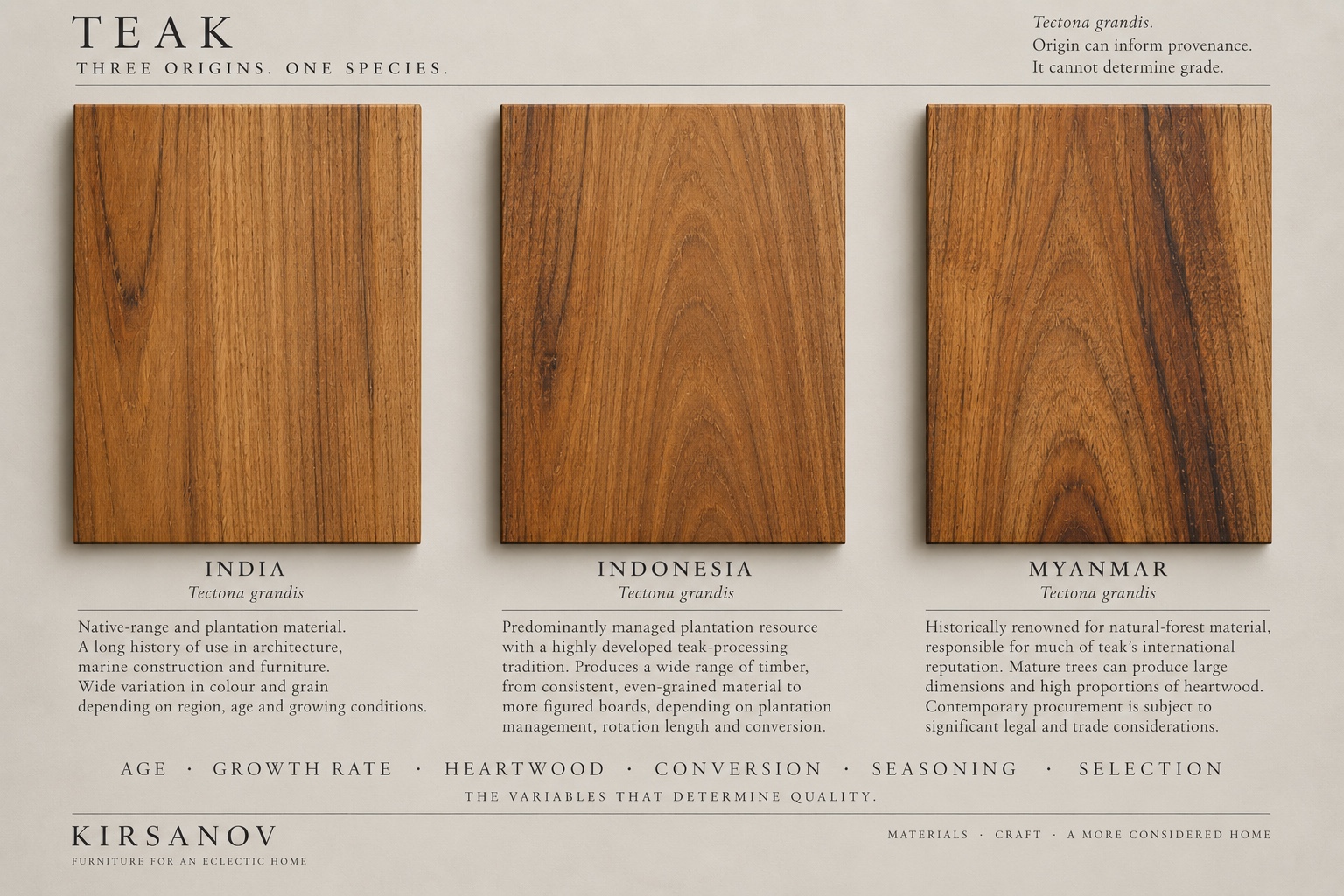
Few timbers have acquired a reputation as durable as teak itself.
For centuries it has been used for ships, buildings, architectural joinery and furniture in climates that rapidly expose weaknesses in lesser materials. Its reputation rests upon an unusual combination of characteristics: natural durability, dimensional stability, mechanical strength, resistance to moisture and decay, relatively low movement in service and excellent working properties.
Yet teak is also surrounded by a considerable amount of mythology.
Burmese teak, Indian teak, Indonesian teak and plantation teak are routinely presented as though they represent fundamentally different materials. Geographic origin is used as shorthand for quality, while the age, growth conditions, heartwood content, seasoning and selection of the actual timber receive considerably less attention.
Botanically, the matter is simpler.
The timber principally understood as genuine teak is Tectona grandis.
The more difficult question is whether all Tectona grandis should be considered equivalent.
It should not.
Understanding why requires looking beyond the species name and examining how the tree was grown, how the timber was converted and seasoned, and ultimately how it is used.
Why Teak Became Important
Teak is native to South and Southeast Asia and has a long history of structural and decorative use.
Its natural durability made it particularly valuable in regions where timber was routinely exposed to humidity, insects and seasonal changes in moisture. Mature heartwood contains natural extractives that contribute to its resistance to fungal decay and many wood-destroying organisms.
Its physical properties are equally important.
Teak combines useful strength with comparatively good dimensional stability. Properly seasoned material behaves predictably in service and is capable of producing large structural components, fine joinery and accurately fitted furniture.
It machines and carves well, holds detail effectively and can produce a smooth finished surface.
Historically these characteristics made teak particularly valuable for shipbuilding. Marine construction subjected timber to conditions considerably more demanding than those encountered by most furniture. Resistance to moisture, decay and dimensional movement were practical necessities rather than aesthetic preferences.
The same characteristics subsequently made teak attractive to furniture makers.
Its reputation was therefore established principally through performance.
Appearance came with it.
What Makes Teak Different?
Freshly worked teak typically ranges from golden brown through deeper brown tones, sometimes containing darker streaks. Exposure to light and oxygen gradually alters the colour, while exterior material will eventually weather towards grey if left unfinished.
The timber has a characteristic tactile quality arising partly from its natural extractives.
Those extractives contribute to teak’s durability but also influence machining, gluing and finishing. The mineral content of some teak can accelerate tool wear.
These are manageable characteristics rather than defects, but they illustrate an important point.
A workshop accustomed to working with teak develops knowledge specific to the material.
Tooling, surface preparation, joint design, adhesive selection, moisture control and finishing all benefit from experience.
The quality of the timber and the competence of the workshop cannot easily be separated.
One Species, Different Timber
The name Tectona grandis identifies the species.
It does not identify the quality.
Two trees of the same species can produce substantially different timber depending upon age, growth rate, climate, soil, silvicultural management and growing conditions.
The distinction between heartwood and sapwood is particularly important.
The pale outer sapwood does not possess the same durability characteristics as mature teak heartwood and is generally less desirable for high-quality furniture intended to exploit teak’s traditional properties.
Age also matters.
As a tree matures, the proportion of heartwood generally increases and larger dimensions become available. Mature trees can therefore produce broad boards and substantial sections that younger plantation trees simply cannot provide.
Growth rate affects grain and density.
Fast plantation growth can be commercially advantageous because it shortens forestry rotations, but rapid production of biomass is not necessarily the same objective as production of exceptional cabinet timber.
Consequently, describing furniture simply as “solid teak” tells us surprisingly little.
The Historical Reputation of Burmese Teak
Myanmar possesses some of the world’s most famous natural teak forests.
Timber originating from these forests acquired an exceptional international reputation, particularly in shipbuilding and architectural work. Mature forest-grown trees could produce large dimensions, high proportions of heartwood and timber of considerable durability.
The resulting reputation became so powerful that “Burmese teak” eventually operated almost as a grade in itself.
That reputation has historical justification.
It should not, however, be confused with a contemporary specification.
Modern procurement must account for legality, traceability and international restrictions as well as physical quality. Historic Burmese teak therefore provides a useful reference for what mature Tectona grandis can become.
It does not necessarily provide a practical model for contemporary furniture production.
India and Teak
India occupies an important position in any discussion of teak because parts of the country fall within the species’ natural range.
The relationship is therefore not recent.
Teak has been used extensively in Indian architecture, shipbuilding, joinery and furniture for centuries. Historic Indian teak structures demonstrate both the quality of material historically available and the considerable experience developed in working it.
There is consequently no botanical basis for assuming that teak becomes inherently superior merely because it carries the name of another producing country.
High-quality Indian-grown Tectona grandis can be exceptional furniture timber.
Equally, poor-quality or immature teak remains poor-quality or immature teak regardless of national origin.
The practical difficulty is establishing precisely what is being offered.
The words “Indian teak” communicate less than they initially appear to.
The more useful questions concern the individual timber.
Where was it grown?
What proportion is mature heartwood?
What dimensions are available?
How was it seasoned?
What defects are present?
What is its moisture content?
And can its origin be documented?
Indonesia and Plantation Teak
Indonesia also has a long and important relationship with teak, particularly on Java.
Teak has been managed extensively through organised forestry systems, including substantial plantation resources developed over several centuries and subsequently incorporated into modern forestry management.
This produced something particularly significant.
Not merely trees, but infrastructure.
Forestry, harvesting, sawmilling, grading, drying and furniture manufacture developed alongside one another. Indonesia consequently became one of the world’s most recognisable producers of teak and teak furniture.
The same qualification nevertheless applies.
“Indonesian teak” is not itself a quality grade.
Plantation timber varies.
Rotation length varies.
Heartwood content varies.
Individual logs vary.
Drying varies.
Selection varies.
Excellent Indonesian teak exists.
So does thoroughly ordinary Indonesian teak.
Geography cannot replace inspection.
The Question of Plantation Teak
Plantation forestry is essential to the future of commercially available teak.
Without managed forestry, global demand for the species would place unacceptable pressure upon remaining natural forests.
The existence of plantations should therefore not be regarded negatively.
The relevant issue is how the plantation has been managed and what quality of timber it has produced.
A longer rotation can allow trees to develop greater dimensions and higher proportions of mature heartwood. Shorter rotations can produce commercially useful timber more rapidly but may result in smaller dimensions and a greater proportion of juvenile material.
Neither category should be judged solely by age.
The intended use matters.
Young plantation teak may perform perfectly adequately in many forms of furniture.
A large cabinet, substantial table or traditionally constructed chair requiring broad sections and carefully selected visible grain may demand something more.
The specification should follow the object.
Provenance Is Not a Grade
This distinction is fundamental.
Myanmar, India and Indonesia can tell us where timber originated.
They do not tell us everything about the timber itself.
A geographic description may suggest particular forestry traditions, growth conditions or historic characteristics, but it cannot establish the quality of an individual board.
For high-quality furniture production, provenance should therefore be considered alongside measurable and observable characteristics:
species identification;
source;
heartwood content;
sapwood allowance;
dimensions;
grain;
defects;
moisture content;
seasoning;
and traceability.
A famous source containing unsuitable timber remains unsuitable timber.
A less fashionable source containing exceptional material remains exceptional material.
Material Provenance and Manufacturing Provenance
There is a further distinction that is frequently overlooked.
The provenance of the timber and the provenance of the furniture are not the same thing.
Timber can travel.
Skills are more difficult to move.
Regions with longstanding traditions of working teak often develop networks of sawmills, drying facilities, joiners, turners, carvers, cabinetmakers, finishers and upholsterers around the material.
This accumulated knowledge matters.
A highly experienced workshop understands not only how to machine teak, but how it behaves after machining. It understands appropriate joint tolerances, seasonal movement, adhesive preparation, surface treatment and the practical limitations of particular sections.
For small-volume and specialist furniture production, this concentration of knowledge can be particularly valuable.
A collection comprising cabinets, beds, chairs, tables and upholstered furniture requires substantially different skills from an industrial production line manufacturing thousands of identical components.
The suitability of a manufacturing location must therefore be judged not simply by its proximity to timber, but by the competence of the network converting that timber into furniture.
Comparing Workshops Rather Than Countries
National comparisons consequently have limited value.
The meaningful comparison is one workshop against another.
India and Southeast Asia both contain manufacturers capable of exceptional work.
Both also contain manufacturers producing ordinary commercial furniture.
The relevant assessment concerns timber selection, moisture control, joinery, machining, carving, finishing, upholstery, dimensional accuracy and the ability to interpret and develop a design correctly.
A mediocre workshop in a famous furniture-producing region remains mediocre.
An exceptional workshop elsewhere remains exceptional.
This becomes particularly important when producing relatively small quantities.
The ability to interpret a drawing, identify an unsuitable construction detail, select appropriate material and maintain consistency across a short production run may be considerably more valuable than the ability to manufacture at enormous scale.
Seasoning and Moisture Control
Teak’s reputation for stability should not encourage complacency.
It remains wood.
Furniture manufactured in a humid tropical environment may subsequently be installed in a centrally heated house, an air-conditioned apartment or another significantly drier interior environment.
That transition matters.
Poorly conditioned timber can shrink after manufacture, opening joints, distorting panels or producing cracks.
Moisture control therefore remains fundamental regardless of species.
Timber should be appropriately dried for its intended service environment, measured rather than assumed to be dry, and given suitable opportunity to acclimatise before critical machining and assembly.
A workshop’s understanding of moisture may ultimately be more important than the country in which the tree grew.
Specifying Teak Properly
A specification stating simply:
Premium Indonesian teak
or:
Premium Indian teak
appears reassuring but communicates remarkably little.
A more useful specification begins with:
Tectona grandis.
It should then address, where relevant, documented origin, heartwood requirements, acceptable sapwood, moisture content, dimensions, visible grain selection, defect limits, drying requirements and traceability.
The degree of specification should reflect the component.
An internal structural member does not require the same visual selection as a cabinet door.
A turned leg requires different grain characteristics from a wide table top.
Material selection should therefore form part of the production drawing and quality-control process rather than appearing as a generic statement applied to the entire object.
The objective is not to use the most expensive teak everywhere.
It is to use the appropriate teak everywhere.
Construction Matters More Than the Label
There is little value in purchasing exceptional teak and subsequently compromising its performance through poor construction.
Wide solid panels require allowance for movement.
Joints need to be appropriate to the loads imposed upon them.
Grain direction matters.
Adhesive surfaces require correct preparation.
Large sections need to have been dried adequately throughout rather than merely appearing dry at the surface.
Finishing systems must be compatible with the characteristics of the timber.
These principles are ordinary cabinetmaking.
Teak does not exempt the manufacturer from them.
Indeed, the cost of good teak makes mistakes considerably less tolerable.
Is Provenance Important?
Yes.
But not in the simplistic manner suggested by geographic labels.
Knowing where timber originated contributes to traceability and can tell us something about the forestry system, likely growth conditions and supply chain behind it.
It cannot tell us whether an individual board is suitable for a particular piece of furniture.
That judgement still requires examination.
For contemporary furniture production, the objective should therefore be neither Indian teak nor Indonesian teak as an end in itself.
It should be correctly sourced, appropriately mature, well-seasoned and carefully selected Tectona grandis, placed in the hands of people capable of understanding it.
The historic reputations surrounding teak are not meaningless.
Burmese teak acquired its status for good reason.
India possesses a genuine and important teak tradition.
Indonesia developed one of the world’s most significant managed teak resources.
Each history tells us something useful.
None removes the need to understand the material itself.
The provenance of teak matters. But not nearly as much as understanding precisely what that provenance has given you.